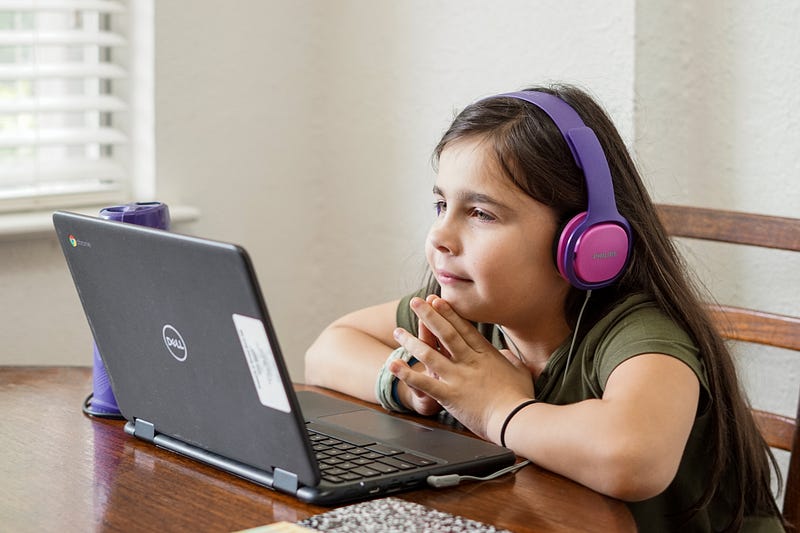
Enhance Your Curriculum with AI: An All-in-One Lesson for Any Class
Unleash the power of AI and embrace the future of education.
Tired of spending hours on end making assignments and writing tests? Teachers are no strangers to the struggle of creating curriculum while managing a packed schedule. Meanwhile, students grapple with difficult concepts while balancing heavy workloads.
To help teachers and students thrive in today’s fast-paced classroom, we have devised the ultimate AI lesson plan! Regardless of grade, subject, and technical knowledge, our custom templates and hands-on worksheets can:
Save hours for teachers by automating curriculum creation
Equip students with the skills to tackle their courses with confidence
Our lesson will turn students into AI experts as they learn how to:
Communicate clearly
Refine AI-generated text
Structure an effective AI prompt
Create useful prompts for school
We even have templates for teachers! Save hours a day by simply filling in the blanks and pasting the text into ChatGPT.
Tailored for Every Class
We offer various flexible lesson plans ranging from 90 to 270 minutes, allowing teachers to effortlessly choose the right lesson for their curriculum’s needs.
The beauty of this lesson lies in its universality. It’s designed to work across subjects, helping students and teachers engage with AI in education without requiring advanced technical knowledge.
Whether learning English, math, or science, students are provided with a foundational understanding of how to interact with AI tools, giving them the skills to become critical thinkers and problem-solvers in our increasingly AI-driven world.
Dive into our AI prompting lesson by clicking on our Google Drive folder and navigating to the “AI Prompting Lesson Guide”. Pick a lesson plan that works best for you, and discover how teaching and learning with AI can be simpler, smarter, and more impactful than ever before.
Looking for practical tools to complement our AI lesson? Check out our blog on the top AI tools for educators! Discover how artificial intelligence in education can streamline tasks, from lesson planning to personalized student support. Unlock new possibilities with these tools and experience the full AI benefits in your classroom.
Discover how ChatGPT is revolutionizing the way we learn STEM subjects.
Unless you have been living under a rock for the past few months, there’s a very high chance that you have heard of ChatGPT in some shape or form.
ChatGPT is taking the world by storm and has been widely discussed about across multiple industries and disciplines. The world of STEM education is no exception. As STEM educators, we are ecstatic about being able to utilize artificial intelligence to help students succeed in STEM. Contrary to some opposing voices on this subject, we believe it’s a great tool to assist in teaching and sparking curiosities in young minds.
Say goodbye to traditional, boring STEM lessons, and hello to ChatGPT’s engaging approach to education.
To put it simply, ChatGPT is a chatbot. It’s an advanced language model developed by an American artificial intelligence research laboratory, OpenAI. It is a type of artificial intelligence (AI) that is trained on large amounts of text data to generate human-like responses to questions and prompts.
ChatGPT uses a deep learning technique called Transformer, which allows it to understand the context of a conversation and respond in a meaningful way. The model has been trained on a massive dataset that includes a wide range of topics and styles, enabling it to generate text that is both informative and conversational.
The winning point about ChatGPT in our opinion is definitely its ability to respond in natural human-like conversations. This is especially helpful in education because it helps to summarize and generate information for various topics in a very informative, conversational, and easy-to-understand way.
To put it simply, think “Google” but with summarized information.
Sounds pretty amazing, right?
How will ChatGPT impact STEM education?
With the rising popularity of ChatGPT, many schools and educators are raising concerns over plagiarism and cheating on homework. Some schools are even going as far as banning it altogether. However, there are far more benefits of using ChatGPT as a companion tool to education than the risks it might bring.
First of all, ChatGPT encourages curiosity. Students can ask questions and receive engaging information on various topics that will help to spark interests. It’s also a great tool to provide personalized learning because it can engage in conversation with students and provide personalized responses based on their questions. This will allow students opportunities to interact with various topics they are interested in and be able to explore the subject further in a personalized experience.
Secondly, ChatGPT is an amazing advancement in technology because it greatly improves the accessibility of information. It’s easy to simply Google on a certain subject but it’s hard to be able to compile all the information out there. ChatGPT has the ability to make this information easier for students to access and learn.
Lastly, combining all the benefits of ChatGPT mentioned previously, we see ChatGPT as an amazing tool to supplement STEM learning. It can help students reinforce concepts learned in class and further encourage their curiosity.
ChatGPT sounds amazing! Are there any limitations?
As with all types of learning tools, ChatGPT is a tool that will greatly benefit students when it’s being used properly.
The most important thing to remember is that ChatGPT should not replace traditional methods of teaching. While it can provide access to information and respond in a human-like way, it will not be able to help students develop important skills such as critical thinking and problem solving skills. Those skills are some of the most important skills that comes with STEM learning and are developed through human interaction and direct instruction.
Rather than trying to ban or go against a new piece of technology, we should switch our mindset to thinking about ways in which we can take advantage of its capabilities to gain new grounds.
(Also, for the teachers and schools who are thinking of banning ChatGPT — the quick answer is no — you cannot ban it because you cannot control students’ access to their own networks.)
We envision a future where teachers and students will be able to embrace AI to supplement education. ChatGPT is a great tool that will be able to elevate STEM learning experience of students as long as it’s used properly. Human instruction in conjunction with machine learning will help students achieve a new state of high-quality STEM education.
Neil Armstrong became the first human to set foot on the lunar surface followed by Buzz Aldrin while their fellow crew Michael Collins stayed in orbit around the moon. 21 hours and 36 minutes later, Armstrong and Aldrin lifted off to join Collins at the Columbia Command Module in the lunar orbit.
Fast forward to more than 50 years later, NASA is returning humans to the moon with the Artemis program.
We’re going back to the Moon for scientific discovery, economic benefits, and inspiration for a new generation of explorers: the Artemis Generation.
With the Artemis program, NASA will land the first woman and first person of color on the Moon with the goal of exploring more of the lunar surface than ever before. Ultimately, learnings from the moon missions will lead to the next giant leap of bringing the first astronauts to Mars.
According to NASA, the Artemis mission will build a community on the Moon, driving a new lunar economy and inspiring a new generation.
Sounds too far into the future? Well — work has already started!
Starting in 2022 and throughout the decade, NASA will send a suite of science instruments and technology demonstrations to the lunar surface. The one that we are the most excited about (so far) has got to be the VIPER.
What is the VIPER?
One of the most critical components of the Artemis program is the discovery of resources on the lunar surface in order to sustain human living on the moon. VIPER does exactly that.
VIPER stands for “Volatiles Investigating Polar Exploration Rover”. It’s a robot robot designed to scout for frozen water and other resources on the moon.
VIPER represents the first resource mapping mission on another celestial body.
VIPER is scheduled to land on the south-pole of the Moon in late 2023. At the size of a golf-cart, the rover venture for at least 100 days into the most shadowed regions of the moon to study and map for water ice deposits.
We are hosting the 2022 edition of the Wiz Prodigy Online STEM Competition right now at Wiz Robotics. This year’s theme will be around the space rover.
Each individual or team registration will come with an at-home robotics kit accompanied by the Wiz online learning platform so you can learn to code and build your rover from scratch.
You can learn more about the 2022 Wiz Prodigy Online STEM Competition directly on the website. Be sure to also check out the amazing Cybertruck creations from the 2021 Wiz Prodigy Competition!
NASA achieved an amazing milestone with the James Webb Telescope on Jan. 24th. What does this mean?
One of the biggest headlines in STEM that happened during the past week has got to be the James Webb Telescope.
NASA announced on January 24th that the $10 billion observatory has finally reached its destination after travelling nearly 1.6 million km (1 million mi.) since its Christmas Day launch.
Why should you care about the James Webb Telescope?
The Webb will help us gaze deeper into the history never seen before! We are talking about the very first stars and galaxies from over 13.5 billion years ago.
The James Webb Telescope Explained
Here are some quick facts that you should know about the Webb Telescope:
At a cost of $10 billion, the Webb Telescope and its flight was the culmination of 25 years of research and development.
It is the largest, most powerful and complex telescope that NASA has ever launched into space.
Artist’s representation of what the unfurled James Webb Space Telescope would look like in space. — NASA
It weights 13,700 lbs — roughly the mass of a full-size school bus.
At 69.5 ft x 46.5 ft (21 m x 14m), the Webb Telescope is comparable to a tennis court.
The Webb Telescope is equipped with a revolutionary set of 18 hexagonal mirror segments. This honeycomb arrangement allows for it to have the largest possible reflective surface area to make observations with the least amount of gap. Read more about the mirrors here and here.
The Webb Telescope is so sensitive that it could theoretically detect the heat signature of a bumblebee at the distance of the moon.
An international team of scientists, engineers, and technicians from 14 countries spent 40 million total hours building the Webb Telescope.
Fun facts
The James Webb Telescope is supposed to be in service for the next 20 years. Have you wondered how it can stay in deep space for so long?
The telescope was launched with a full tank of maneuvering fuel, enough for it to operate for at least 10 years — not bad, but not nearly as long as the 32 years and counting that the Hubble Space Telescope has been in service in a stable low-Earth orbit, where it needs no such fuel.
So… How is the Webb going to stay in service?
Of course the engineers had already considered this aspect. They had built the Webb with a special refill port that would allow for a spacecraft to come in and fuel the tank.
The catch is — this type of spacecraft doesn’t exist yet and NASA only has a decade to make it happen.
But no need to worry!
The European Space Agency Ariane 5 rocket that launched the Webb placed it on a trajectory so true that the telescope had to use virtually none of its precious fuel on outward-bound course corrections, extending its operational life to what engineers now predict could be 20 years or more.
So there we go! Problem solved.
The first images from the Webb Telescope is expected to come in 6 months or earlier. We can’t wait to see how they look like!
Each individual or team registration will come with an at-home robotics kit accompanied by the Wiz online learning platform so you can learn to code and build your own robotics space rover.
You can learn more about the 2022 Wiz Prodigy Online STEM Competition directly on the website. Be sure to also check out the amazing Cybertruck creations from the 2021 Wiz Prodigy Competition!