Categories
AI Stem Education

Top 3 Trends in STEAM Education for 2024

Thriving in Tomorrow’s Classroom: Top 3 Trends in STEAM Education for 2024

Welcome to 2024, where, despite the absence of a human colony on the Moon (come on NASA!) – we are undeniably living through the future of education with even more emphasis on STEAM education. 

STEAM (Science, technology, engineering, arts, and mathematics) will continue its momentum as an important pillar of K-12 school curriculums around the world to better prepare students for the complexities of the modern world. However, this journey can be both thrilling and perplexing for parents. 

This blog is your dedicated guide to the latest trends in STEAM education, personalized for parents seeking to empower their children on the path to academic success and future opportunities in 2024 and beyond! 

Wiz Robotics staff picking up robotics pieces

What is STEAM?

STEAM stands for Science, Technology, Engineering, Arts, and Mathematics. It is a merger of subjects with the goal of developing technical and critical thinking skills for modern learners. 

STEAM education has been – and will continue to be – a hot topic worldwide. Governments worldwide are continuously looking for ways to help students build the solid foundation they need for the future. 

Read more about this on our blog STEM in the Curriculum: 5 reasons why it’s important. 

Why is STEAM important 

STEAM education is important for students as it provides a range of skills and competencies that could easily be adapted across disciplines.

Some of the key reasons for STEAM education include: 

  • STEAM education encourages innovation and creativity. 
  • STEAM education helps to develop science literacy. 
  • There are many transferable skills that students could learn from STEAM education including problem solving, critical thinking, team work, and communication. 

Read more about skills in our blog articles: 

Navigating the digital classrooms

During the last couple of years, digital classrooms have taken off as essential tools in education. The integration of digital tools and online platforms with in person teaching has become instrumental in providing dynamic and accessible educational experiences for students. As a parent, there will be tricky parts as you help your children adapt to the new environment. Let’s delve into the increasing role of digital tools, share tips for success,, and highlight the significance of cultivating digital literacy skills in the modern educational landscape. 

Artificial Intelligence and STEAM Education

Artificial Intelligence (AI) has undeniably taken the world by storm in the past year. We ran a simple comparison of Google trends on the worldwide interests for STEM education vs. AI education and AI has overtaken STEM education. AI will continue to be a trend for education in 2024 and beyond.  

AI has existed for a while but has only become more relevant to the general public with the launch of ChatGPT. Despite some of the debate about AI’s role in education, we believe that it’s an important tool that could help with students’ learning. 

Read more about how AI can supplement education in our blog post. 

We envision a future where teachers and students will be able to embrace AI to supplement education. ChatGPT is a great tool that will be able to elevate the STEM learning experience of students as long as it’s used properly. 

VR & AR for STEAM education 

Technological advancement will continue to push immersive learning as a trend for 2024. Immersive learning involves using technologies such as virtual reality (VR) and augmented reality (AR) to create engaging and interactive educational experiences. 

Side note – have you seen the latest Apple Vision Pro? We can’t wait to see how this could be applied for education. 

Immersive learning can transform the way students learn STEAM. VR and AR will be able to let students experience scenarios and apply their knowledge in simulations that would otherwise be impossible in real life. Additionally, it makes learning more interactive and engaging. Students will be able to visualize complex data and tools better with the help of VR and AR tools. 

This is a trend that we are the most excited about and we would love to see more opportunities of applying it in STEAM education. 

Continuous push for STEAM education in the curriculum

Back in 2022, the Government of Ontario revamped high school courses in science, technology, engineering, mathematics (STEM), to ensure students are better prepared for the workforce of tomorrow. Updates to 2024 include “a new Technological Education curriculum, beginning with revised Grade 9 and Grade 10 courses” happening in September. 

Source: Ontario Modernizing Computer Studies and Tech-Ed Curriculum to Ensure Students Are Prepared for the Jobs of the Future

Similarly, many other governments around the world are continuing to push for emphasis on STEAM education.

Hear from Wiz

Our team at Wiz Robotics are very excited about these exciting trends happening in the STEAM education space and we can’t wait to share learnings and resources with our students and parents.

STEAM education is important and governments are taking action. The rising trend of mandatory technology courses across various school boards underscores the necessity for students to become more technically proficient. Many parents think that this just means giving students technology – but that isn’t really it. It is teaching students to be software adaptable, being proficient at coding, and learn general math skills and such.

– JF, Wiz Robotics

Tips for success

Navigating digital classrooms can be challenging for parents and students alike but can also be a rewarding experience.

Here are some tips for success:

  • Familiarize yourself with the digital tools and platforms so you can help your children on this journey
  • Digital literacy goes beyond learning about making decisions based on facts and research. It’s a good opportunity to educate your children on online safety, privacy, and instill good habits regarding online behaviour. 
  • Promote self-advocacy with your children as digital classrooms and tools pose a different dynamic as in-person learning. Encourage them to ask questions, seek clarification, and communicate with teachers when needed.
  • Be patient with both yourself and your children as navigating new tools will be a learning process for both of you. 

Still confused about what to do next? 

At Wiz Robotics, we have exciting STEM learning programs to help you get started with STEM education. Our programs offer exciting and engaging hands-on opportunities for students to be equipped with the knowledge they need to succeed.

Try a demo class and see for yourself!

Connect with us

Facebook / Instagram / Website

Categories
Coding Competition Education Resources Stem Education

Top 5 Programming Languages for Middle and High School Students

mother helping her daughter with her homework

Quest for Code 2024: Navigating the Top 5 Programming Languages for Middle and High School Students


The world of STEM is constantly changing and evolving. Whether your child is taking their first steps into the world of programming, contemplating where to begin, or already a seasoned coder, our 2024 Quest for Code guide will help you navigate through it all. 

These top 5 programming languages are not just used in the real world, they also serve as foundational blocks for every enthusiastic STEM student. Let’s embark on this adventure together to demystify the coding realm for students of all levels!

Table of Contents

Scratch

Scratch is a visual programming language designed specifically for children as an educational tool. Its high-level block-based visual programming language allows children create their own digital stories, games, and animations.

Scratch promotes computational thinking and problem solving skills, creative teaching and learning, self-expression and collaboration, and equity in computing – all extremely important skills of STEM that children can apply in real world situations!

MIT Media Lab, Developers of Scratch
Related reading

Scratch is essential for beginners as it is highly visual and easy to learn. It provides a good introduction to coding and computer science fundamentals. The target age group for Scratch is 8-16 years old. However, this shouldn’t deter you from introducing programming to younger children! ScratchJr was developed for children aged 5-7. It enables children to create their own interactive stories and games by snapping together visual programming blocks. 

Before you jump to conclusions, it’s also important to acknowledge some of the shortfalls of Scratch. While it’s a useful tool to introduce children to programming, it doesn’t provide progression to text-based programming. Additionally, there are also no advanced programming features that might become crucial as your children become more knowledgeable and comfortable with programming. 

Python

Python is a high-level, general-purpose programming language that is widely regarded as an excellent language to begin with. It has a clear and readable syntax, making it easy for students to grasp programming concepts. Python is versatile and used in various fields including web development, data science, software development, and even artificial intelligence. It’s a great language for children to learn and start developing their own websites and games!

Python remains one of the most popular programming languages out there in the world with a large active community. This is a great advantage because having an active community means having a great resource for helping to solve issues! You won’t need to worry if your child encounters a coding problem because most likely there is somebody out there who has encountered it as well. 

girl in pink t shirt looking at the imac

Bonus Tip:

Did you know that you could build your own bots with Python for Discord? The creativity is limitless with bots on Discord. Discord users often create these bots to enhance user experience and functionality. This is a fun way to get students excited about learning Python and applying it in a real world scenario.

There are many good things about Python but we should also take note of some of the shortcomings of this language. Python uses simple language which can also become a drawback for someone who becomes accustomed to it as it would be harder to learn a new language. This leads to the other complication that large enterprises don’t really use it as it’s not the most secure and is often difficult to integrate with complex layers of databases. 

Ruby

Ruby is a dynamic, open source programming language with a focus on simplicity and productivity. It is similar to Python in the sense that it’s easy to read and write. People mainly use it to build web applications, building servers and data processing, web scraping, and crawling. 

Ruby is less common than the other languages mentioned in the post. However, according to Pluralsight, an online education company, Ruby definitely has the edge over Python when it comes to web development. 

The downside to this is that Ruby’s community is small and primarily only focuses on web development.

Java

Java is another versatile and widely-used programming language that allows developers to create software applications for a variety of devices and platforms. It’s especially popular for web development and mobile app development, particularly for Android devices. 

Java helps to build a solid foundation for children because it introduces key programming concepts such as object-oriented programming, variables, and loops. These are important foundational concepts for understanding complex languages and programming concepts. This would be especially helpful if your child is interested in pursuing a career in computer science as it serves as a stepping stone for more complex programming languages.

Bonus Tip:

Java is used for University of Waterloo’s Canadian Coding Competition (CCC) along with C, C++, Python 2, and Python 3 as the recommended languages. Learn more about the CCC and how Wiz Robotics can help here

photo of woman and boy looking at imac

The downside of Java is that it can get fairly verbose – this means that it may take more lines of code to achieve certain tasks. Although it’s designed to be user-friendly, there’s still a bit of a learning curve for beginners.

C++

C++ first appeared 38 years ago. Despite its relatively “old” age, it’s still a very relevant programming language to learn in 2024. C++ is a general-purpose programming language that is widely used in various industries, including game development, system programming, and embedded systems. 

mother helping her daughter use a laptop

Bonus Tip:

C++ is used a lot in Arduino. This would give students who are especially interested in hardware engineering a head start as they would have gotten a lot of practice already using the language.

As a beginner, C++ might not be the easiest programming language to learn. However, it’s very rewarding once you are able to grasp it. C++ helps to build a solid foundation in programming with a structured approach to learning.

Bonus: Roblox for Games development 

Tired of reading about programming languages? Let’s talk about something more fun! Did you know that games can also be a tool for learning programming?

Roblox Studio is an advanced game development program, exclusive to Windows and macOS. This is a great tool to use if your child has a special interest in games development. Its powerful and user-friendly tool enables users, particularly game developers, to build their own virtual worlds and games within the Roblox ecosystem.

Roblox Studio has many features including using Lua programming language for scripting. The powerful script engine lets developers control game mechanics, create interactions, and customize the behaviour of in-game objects. It’s accessible for both beginners and advanced developers.


Summary

If you have made it this far down the blog – congratulations! Now you have a general knowledge of some of the most popular programming languages for students out there.

We have compiled a summary chart of each of these programming languages and notes about them to help guide you through the differences.


Wiz Robotics is no stranger to teaching any of these programming languages to our students. Whether your child is just starting out and trying to explore the different programming languages out there or if they are looking to advance their skills, there is something for everyone here at Wiz. 

To learn more about how your child can get started on STEM, visit www.wizrobotics.com 

Categories
AI Education Resources Science & Tech Stem Education

The Future of Personalized STEM Learning

Discover how ChatGPT is revolutionizing the way we learn STEM subjects.


Unless you have been living under a rock for the past few months, there’s a very high chance that you have heard of ChatGPT in some shape or form.

ChatGPT is taking the world by storm and has been widely discussed about across multiple industries and disciplines. The world of STEM education is no exception. As STEM educators, we are ecstatic about being able to utilize artificial intelligence to help students succeed in STEM. Contrary to some opposing voices on this subject, we believe it’s a great tool to assist in teaching and sparking curiosities in young minds.

Say goodbye to traditional, boring STEM lessons, and hello to ChatGPT’s engaging approach to education.

Photo by Andrea De Santis on Unsplash

But first… What is ChatGPT?

To put it simply, ChatGPT is a chatbot. It’s an advanced language model developed by an American artificial intelligence research laboratory, OpenAI. It is a type of artificial intelligence (AI) that is trained on large amounts of text data to generate human-like responses to questions and prompts.

ChatGPT uses a deep learning technique called Transformer, which allows it to understand the context of a conversation and respond in a meaningful way. The model has been trained on a massive dataset that includes a wide range of topics and styles, enabling it to generate text that is both informative and conversational.

Photo by Arseny Togulev on Unsplash

The winning point about ChatGPT in our opinion is definitely its ability to respond in natural human-like conversations. This is especially helpful in education because it helps to summarize and generate information for various topics in a very informative, conversational, and easy-to-understand way.

To put it simply, think “Google” but with summarized information.

Sounds pretty amazing, right?

How will ChatGPT impact STEM education?

With the rising popularity of ChatGPT, many schools and educators are raising concerns over plagiarism and cheating on homework. Some schools are even going as far as banning it altogether. However, there are far more benefits of using ChatGPT as a companion tool to education than the risks it might bring.

First of all, ChatGPT encourages curiosity. Students can ask questions and receive engaging information on various topics that will help to spark interests. It’s also a great tool to provide personalized learning because it can engage in conversation with students and provide personalized responses based on their questions. This will allow students opportunities to interact with various topics they are interested in and be able to explore the subject further in a personalized experience.

Photo by John Schnobrich on Unsplash

Secondly, ChatGPT is an amazing advancement in technology because it greatly improves the accessibility of information. It’s easy to simply Google on a certain subject but it’s hard to be able to compile all the information out there. ChatGPT has the ability to make this information easier for students to access and learn.

Lastly, combining all the benefits of ChatGPT mentioned previously, we see ChatGPT as an amazing tool to supplement STEM learning. It can help students reinforce concepts learned in class and further encourage their curiosity.

Photo by Thomas Park on Unsplash

ChatGPT sounds amazing! Are there any limitations?

As with all types of learning tools, ChatGPT is a tool that will greatly benefit students when it’s being used properly.

The most important thing to remember is that ChatGPT should not replace traditional methods of teaching. While it can provide access to information and respond in a human-like way, it will not be able to help students develop important skills such as critical thinking and problem solving skills. Those skills are some of the most important skills that comes with STEM learning and are developed through human interaction and direct instruction.

(Read more: How can STEM Competitions Help Develop Problem Solving Skills?, Top 5 Reasons for Learning STEM)

Additionally, as with exploring topics through Google, the information on ChatGPT will need to be vetted and verified for accuracy.

Photo by Taylor Flowe on Unsplash

Rather than trying to ban or go against a new piece of technology, we should switch our mindset to thinking about ways in which we can take advantage of its capabilities to gain new grounds.

(Also, for the teachers and schools who are thinking of banning ChatGPT — the quick answer is no — you cannot ban it because you cannot control students’ access to their own networks.)

We envision a future where teachers and students will be able to embrace AI to supplement education. ChatGPT is a great tool that will be able to elevate STEM learning experience of students as long as it’s used properly. Human instruction in conjunction with machine learning will help students achieve a new state of high-quality STEM education.

Photo by Maxim Hopman on Unsplash

Let us become your partner in STEM education!

At Wiz Robotics, our STEM classes offer exciting and engaging opportunities for students to practice problem solving and critical thinking skills.

Try a demo class and see for yourself!

Connect with us

Facebook / Instagram

Categories
Competition Education Resources Engineering Stem Education

Top 5 Unique STEAM Careers in 2024

A year ago, we wrote about 5 Unique Jobs in STEM You Didn’t Know Existed. Fast forward to 2023, we now have an updated list of super interesting careers that will make you excited about having a future in STEAM!


STEM is short for Science, Technology, Engineering and Math. If you mix in “Art”, it becomes STEAM.

In the past, STEM fields have suffered from stereotypes partly influenced by media portrayals. According to a study conducted in 2018, negative stereotypes surrounding STEM have actually deterred women from pursuing STEM and being motivated to pursue these fields.

Photo by Desola Lanre-Ologun on Unsplash

Our goal at Wiz Robotics is to inspire future engineers, entrepreneurs & innovators. It’s time to change the how STEM careers have been perceived and motivate the future generation to think differently about the vast number of possibilities that STEM could bring.

Having said that, we are very excited to share with you our updated list of Top 5 Cool STEAM Careers to Consider in 2023!


Pastry Chef

Have you wondered why chocolate needs to be tempered before reaching the most optimal state for eating and baking? Or why adding different ingredients can result in different cake textures?

It’s all science!

Baking is part science, part math, and part art. Pastry chef is the perfect demonstration of a STEAM career that combines STEM, creativity, and art. Getting the most optimal combination of texture, taste, and presentation is not as easy as it seems.

In order to become a pastry chef, you would need formal training through an accredited facility. Some hiring managers might even prefer a bachelor’s degree.

If you are as passionate about pastries (or eating them) as I am, this is a fun and unique career to consider!

Photo by Elevate on Unsplash

Game Physics Programmer

What if I told you that you CAN have fun by studying physics?

A Physics Programmer apply math and physics to the art of game design. They are the ones whose code could enable you to experience shockwaves of an explosion in the game or a car crashing through the waves as if you were physically there in the virtual world.

Physics programmers requires a high level knowledge of physics and programming. They also should have a sense of gameplay and know how to blend in realism in games with fun components.

Being a physics programmer will make your dream of playing games for work become a reality.

Photo by Sean Do on Unsplash

Underwater Archaeologist

What does Titanic, Treasure Island, and Life of Pi share in common? — Shipwrecks!

Underwater or Marine archaeology is a field of archaeology practiced underwater. According to the National Marine Protected Areas,

Underwater Archaeology is the systematic documentation and recovery of information from submerged artifacts and underwater sites for the interpretation of past human cultures. Artifacts and sites, the locations of past human activity, possess information about human behavior in both the nature of the objects and in their exact distribution on or under the seafloor.

In simple words — shipwrecks and lost treasures!

Underwater archaeologists will get to dive deep into the ocean to discover the secrets of the ocean depths and search for shipwrecks and lost civilizations.

There are only around 15 universities worldwide that offer a degree in marine or underwater archeology. Diving training is also a must. Most professionals have a master’s or doctorate in this field.

Photo by NOAA on Unsplash

Medical Illustrator

“I love science but I also love art. Is there a job where I can do both at the same time?” YES — Medical illustrator is the answer.

A medical illustrator combines their expert knowledge of health sciences and artistic ability to explain medical principles and theories to the public. Their work may appear in textbooks and scientific journals, including educational materials such as brochures or booklets, video tutorials, and in-person exhibitions.

There are no undergraduate programs in medical illustrations. Professional medical illustrators often earn a master’s degree in medical illustration from an accredited graduate institution. Admission requirements general involve a bachelor’s degree with a major in art and a minor in the biological sciences, or a major in science with a minor in art, is preferred. On top of that, a portfolio of artwork and a personal interview are generally required.

Photo by Robina Weermeijer on Unsplash

3D Printing Engineer

3D technology is becoming a game changer in making technological advances in the world. It’s also one of the rapidly emerging fields.

3D Printing allows engineers to create sometimes extremely complex prototypes efficiently. Being able to understand and know how to operate 3D printing is very valuable.

In order to become one, you typically need a degree in engineering. Some of the more relevant fields are: Materials & Chemical Science, Mechanical Engineering, Electronic Engineering/Mechatronics, and Civil Engineering. However if you are more interested in the design aspect of 3D printing, 3D Modelling/Industrial Design is the degree to go for.

Photo by Tom Claes on Unsplash

A career is STEM is not about doing “boring work in unpleasant settings”. It’s important to show students the diverseness of the industry to get them excited about a future of STEM.


Let us become your partner in STEM education!

At Wiz Robotics, our STEM classes offer exciting and engaging opportunities for students to practice problem solving.

Try a demo class and see for yourself!

Connect with us

Facebook / Instagram

Categories
Uncategorized

Get to know the CCC

Let’s deep dive into the format and structure of the Canadian Computing Competition (CCC)!


Photo by Element5 Digital on Unsplash

Are you a student who is…

  • Currently in high school?
  • Passionate about computer science?
  • Interested in pursuing STEM majors?
  • Looking to stand out in university applications?

If the answer is YES to all of the above bullets, then the Waterloo CCC might be the competition for you!

The Canadian Computing Competition (CCC) is a challenging but rewarding STEM competition for high school students who are passionate about pursuing STEM. In our previous blog post, we talked about what the CCC is and how it could help with university applications. Today, we will deep dive into the format and structure of the competition to help you become familiar with it and ultimately succeed!

The 2023 CCC will be held on Feb 7th, 2023. There’s less than a month away from the deadline but there’s still time to prepare!

Read on to find out how to best prepare for the CCC.


So what exactly is the CCC?

The CCC stands for the Canadian Computing Competition. It’s meant to be a fun challenge for participants with an interest in programming. You might often hear the CCC being referred to as the “Waterloo CCC” and that’s because the competition is organized by the Centre for Education in Mathematics and Computing (CEMC) at the University of Waterloo.

Photo by Jeswin Thomas on Unsplash

How is the CCC written?

The CCC is written in schools by using the CCC Online Grader. The online grader provides immediate feedback on solutions to algorithmic programming problems. Not only is it used in competitions, it also hosts a library of past competition problems to help students practice and prepare for the challenge.

It’s important to get familiar with the CCC Online Grader on the University of Waterloo website so you are better prepared for the actual competition.

What is the format for the CCC?

The CCC is a 3-hour long challenge consisting of 5 questions for both the Junior level and the Senior level competition. The Junior level is for those with beginner programming skills while the Senior level is for participants with intermediate to advanced programming skills.

An important thing to note is that teachers need to register in order for contests to be written in schools. There is no team competition.

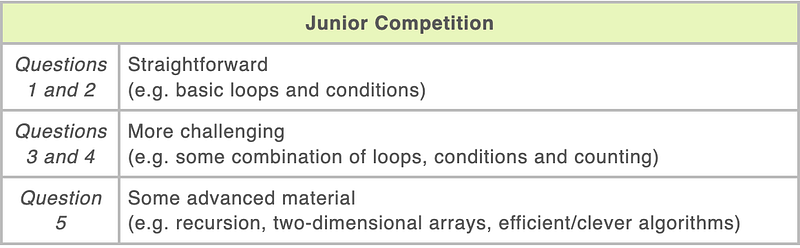
Each question of the CCC is worth 15 points. The questions start on a relatively easy difficulty level and increase with each question. The CEMC has provided an outline of the questions to help you with your prep.

Source: CEMC — CCC Format and Languages

More information on the competition can be found on the CEMC website.

Photo by Marvin Meyer on Unsplash

What are the languages required for the CCC?

According to the CEMC website, CCC participants may use C, C++, Python 2, Python 3, Pascal, Java, Perl, or PHP.

What else is there to know about the CCC?

There are a full set of rules for teachers and students on the CCC. It’s important to know these rules so you are able to participate in the competition.


What is the best way to prepare for the competition?

Once you have decided to participate in the CCC, we highly recommend you to spend some time preparing for it.

The most popular and well-known (also FREE) method of preparing is the CCC Online Grader. All you need to do is create an account and you can start accessing previous competitions and practice for free.

You can discover more ways directly through the CEMC website.

At Wiz Robotics, we have designed a CCC prep course to help you in this journey. All you have to do is enroll in the course, attend classes, and practice!


Participating in the CCC is a challenging but rewarding experience. We strongly encourage aspiring STEM students who are passionate about computer science and mathematics to try out first hand at the competition.

At the end of the day, you have nothing to lose but lots (of skills and knowledge) to gain!


Connect with us

Facebook / Instagram

Categories
Uncategorized

Why should you take the CCC?

And how to prepare for it?


Have you heard of the CCC? Did you know that participating in the CCC might help you with university applications and scholarships?

If not, then you’ve come to the right place! (But don’t click away even if you have! We want to see you succeed so read on to find out how.)

We are a little bit less than a month away from the 2023 CCC but there’s still time to start getting familiar with it.

In today’s blog, we will cover the following topics:

  • What is the CCC?
  • When is the CCC?
  • Who is the CCC for?
  • Why should you take the CCC?
  • How to best prepare for it?

So what exactly is the CCC?

The CCC stands for the Canadian Computing Competition. It’s meant to be a fun challenge for participants with an interest in programming. You might often hear the CCC being referred to as the “Waterloo CCC” and that’s because the competition is organized by the Centre for Education in Mathematics and Computing (CEMC) at the University of Waterloo.

“Designed to be both accessible to participants with some programming experience and to challenge the keenest programmers at the secondary school level, the CCC helps participants build confidence and grow their ability to design, understand and implement algorithms.”

The 2023 CCC is coming up soon!

The CCC is held online every year in February. The deadline for ordering the 2023 CCC is February 7, 2023.

If you are a secondary school student with a special interest in programming, then this is the competition for you!

There’s no need to be stressed out about competing with others who might be more experienced in programming because according to the official CCC guidelines, participants may choose to write at the Junior or Senior level of the competition.

The Junior level is for those with beginner programming skills while the Senior level is for participants with intermediate to advanced programming skills.

But HEY! Who doesn’t love a challenge?

Photo by Arif Riyanto on Unsplash

Why should you take the CCC?

Similar to any type of STEM competitions, participating in the CCC yields many benefits including:

  • Challenge yourself and your problem-solving skills
  • Discover and grow your passion in mathematics and computer science
  • Develop critical thinking skills
  • Further enhance your programming skills and demonstrate your abilities

As further reading on the benefits of participating in STEM competitions, be sure to check out our previous blog article: How STEM Competition Help Develop Problem Solving Skills?

However, one of the most important reasons for participating in the CCC from our perspective is that it serves as a critical asset for university applications.

Photo by Vasily Koloda on Unsplash

University of Waterloo specifically pointed out that while contest participation is not a requirement for admission, they strongly encourage applicants to participate, as it is an asset to their application and can help in making Faculty scholarship decisions. This is especially important if you are applying for the Computer Science program because the CCC is an opportunity to test students’ ability in designing and understanding algorithms, as well as in programming.

If University of Waterloo is your dream school, don’t miss out on the opportunity to try the CCC!


Ready to participate in the CCC? Here are some ways to prepare yourself for it

Once you have decided to participate in the CCC, we highly recommend you to spend some time preparing for it.

The most popular and well-known (also FREE) method of preparing is the CCC Online Grader. All you need to do is create an account and you can start accessing previous competitions and practice for free.

You can discover more ways directly through the CEMC website.

At Wiz Robotics, we have designed a CCC prep course to help you in this journey. All you have to do is enroll in the course, attend classes, and practice!


Participating in the CCC is a challenging but rewarding experience. We strongly encourage aspiring STEM students who are passionate about computer science and mathematics to try out first hand at the competition.

At the end of the day, you have nothing to lose but lots (of skills and knowledge) to gain!


Connect with us

Facebook / Instagram

Categories
Uncategorized

The #1 Thing We Are Missing in Sustainability

There are a ton of resources and articles online that talks about STEM’s role in helping to solve sustainability issues of the world. However, there’s an important missing piece of the puzzle that’s not being as widely discussed as it should have been — read on to find out more!


Photo by Noah Buscher on Unsplash

Sustainability is an ongoing topic that should not be ignored. In fact, the United Nation has declared 17 Sustainable Development Goals, which are urgent calls to action for all countries in a global partnership to strive towards peace and prosperity for the people and the planet.

Education is an important component of it all. There’s a growing awareness of STEM and STEM education in helping to solve sustainability issues of the world.

The golden question is — how do we create an education system that’s going to inspire and change the world for future generations?


Our very own Curriculum Director of Wiz Robotics, J. F. Michaud had the opportunity to speak at the Science Summit at the United Nations General Assembly back in September to talk specifically on the role of languages and STEM education in meeting the UN’s sustainable development goals.

Pictured above: Wiz Robotics Curriculum Director, J. F. Michaud

I had the chance to chat with J.F. after his presentation and here are the most important things I learned.

The missing puzzle piece of the sustainability discussion — the call-to-action

We already are aware of STEM’s role in helping to solve sustainability issues. We always hear about them through articles, on the news, in popular culture, and in classrooms. However, we are often missing the call-to-action and not emphasizing on creating solutions for these problems.

Photo by Artem Maltsev on Unsplash

Our very own FLL (FIRST Lego League) team is actually working on an innovative project as a call-to-action to sustainability issues. The team is made up of a group of students from Grades 4–8 and they are designing a bike to create a cycle that generates food.

The bike the team is working on is an exercise bike with a generator that connects to the bike. When the bike generates energy, it then stores energy in a battery and provides light for an indoor garden. The entire bike is creating a cycle that generates energy to produce food, and then the energy gets transferred back to human!

Watch out — Peloton!

Photo by Bonnie Kittle on Unsplash

STEM education should be focused on engaging students and inspiring them to use technology to solve problems. The call-to-action is the missing puzzle piece that we should not ignore!

While our FLL team’s innovative bike is a great example of a call-to-action, there are many other things closer to home that we could do to help with the solution.

We should rethink how we interpret the traditional 3R’s of sustainability

We have all been taught what the 3 R’s of sustainability are: Reduce, reuse, recycle.

People often think that recycling means throwing things in the recycling bin and then something new comes out of it in the end. While it’s true, the more appropriate way to look at “recycling” is reuse and repurpose at home before throwing it away.

Photo by Noah Buscher on Unsplash

For example, the holiday season means we might be receiving a lot of delivery boxes. Before we flatten those boxes for the recycling bin, maybe we could think about reusing them for ship out items to friends and family before purchasing new delivery boxes.

During our previous Wiz Prodigy Online STEM Competitions, we also encouraged participants to find items at home to reuse and repurpose for their Cybertruck or space rovers!


Tackling sustainability is not an easy task. That’s why we aim to inspire young minds to become future leaders of the world through STEM learning.

Learn how!

Connect with us

Facebook / Instagram

Categories
Competition Education Resources Stem Education

Cost vs. Benefit of STEM Education

Hey parents! Let’s talk some numbers behind STEM education.


Everybody is “STEM-ing” these days. Coupled with the announcement from the Ontario Ministry of Education earlier this year, STEM education is no longer a topic that can be ignored.

Photo by Ralston Smith on Unsplash

So what is STEM again?

It’s short for Science, Technology, Engineering and Math. It is a merger of subjects with the goal of developing technical and critical thinking skills for modern learners.

At Wiz , we are passionate about STEM education and we can’t stress enough the importance of learning STEM for the younger generation. As we had written about previously in our blog, STEM education is a global endeavour to help children and youths to prepare for the future of STEM. Governments worldwide are looking for ways to help students build the solid foundation they need for the future.

Pictured above: Wiz Robotics class

Why should students learn STEM?

Problem solving is one of the most important skills for children’s development. It’s also one of the most essential skills used in STEM education. Students are encouraged to learn the required knowledge as well as think outside of the box to solve different challenges and problems. It’s an extremely valuable way for students to develop the problem solving skills that are critical to their future successes.

Read more about building problem solving skills in STEM competitions.

STEM also teaches transferable skills that students can use throughout their lives. Critical thinking, being innovative, as well as project management skills are just some of the examples that students will be able to pick up during their STEM journey.

Read our previous blog posts to find out how Wiz programs can help develop these skills:

Photo by Aedrian on Unsplash

So now we know all the benefits of STEM, let’s talk some numbers.

STEM careers continue to be some of the fastest growing occupations in the US and Canada. The US Bureau of Labor Statistics is projecting the number of jobs in STEM fields to grow by nearly 10% between 2019 and 2029. That’s twice the rate of growth for all other occupations!

According to the 2016 census by Statistics Canada, the average income of a STEM graduate is more than $15,000 higher than graduates of non-STEM fields. It’s a similar situation in the United States. The median salary for STEM occupations was $98,340 in 2020, with computer and information systems managers earning an average of $161,70 per year.

Photo by Susan Holt Simpson on Unsplash

STEM careers have a bright outlook. But how much does it cost?

First and foremost, cost can be a barrier to STEM education. According to a recent UScellular survey, almost half of students surveyed agree that pursuing a path in a STEM-related field would be too costly or too difficult.

Some of these costs include:

  • Obtaining a university degree in STEM — Bachelor’s degrees can cost anywhere between $50,000 and $130,000 in tuition for a four-year program.
  • Extracurricular STEM programs and classes — Generally speaking, these STEM programs and classes outside of school starts at around $300+ for a set of sessions. Additional costs also apply when you consider camps to continuously pursue STEM even during the summer holidays.
Photo by MD Duran on Unsplash

Don’t fret — there are many resources out there to support children’s interests in STEM!

STEM education doesn’t have to come with a massive price tag. There are many ways to engage with children on their interests and get them to practice STEM skills on a daily basis.

For example, we had outlined five ways that you can incorporate STEM everyday in a previous blog post. These methods will help you continue the conversation at home with your children on STEM through daily activities and discussions.

Additionally, there should be local resources in your city that are free or low cost for the whole family to enjoy STEM. The local public library is a great place to start. For those in the Toronto area, the Toronto Public Library is a treasure chest full of resources and programs for free. If the library doesn’t have the STEM information you need, you can always pay a visit to the Ontario Science Centre in person or access their virtual resources.

Photo by Andie Kolbeck on Unsplash

Don’t forget about STEM competitions!

Did you know that some STEM competitions are very affordable to participate in and can also be done virtually! STEM competition are a great opportunities for children to develop STEM skills while having fun.

Take our Wiz Summer Innovators Competition for example, participants were given challenges to complete while playing Roblox. What’s better than playing games and learning STEM along the way?

Pictured above: Previous WSI Winner

Ready to take on the next level of STEM learning?

At Wiz Robotics, our STEM classes offer exciting and engaging opportunities for students to practice problem solving.

Try a demo class and see for yourself!


Connect with us

Facebook / Instagram

Categories
Uncategorized

“Try the Impossible” — Inside the Minds of FTC Team Captains

STEM learning extends beyond classrooms. We have been strong proponents of STEM competitions as an opportunity for students to challenge themselves and apply their learnings. In today’s blog post, we sat down with two students who are currently captains of their teams for the FIRST Tech Challenge.


At Wiz Robotics, not only do we organize our own STEM competitions such as the Wiz Prodigy Online Competition and the Wiz Summer Innovators Challenge, we also have our own students participate in external competitions. Competitions create a valuable opportunity for students to learn and apply STEM skills as well as other transferable skills such as problem solving and critical thinking skills.

We had a chance to chat with two Wiz students who are also captains of their teams for the FIRST Tech Challenge (FTC) on their STEM journey and experience leading their teams.

FIRST Tech Challenge, formerly known as FIRST Vex Challenge, is a robotics competition for students in grades 7–12 to compete head to head, by designing, building, and programming a robot to compete in an alliance format against other teams.

Let’s meet…

Pictured above: the Pr0teens team

Leo, captain of the Pr0Teens FTC team, and Michelle, captain of the DG (Drive Gears) team. Both Leo and Michelle are Grade 11 students who are passionate about STEM. This year will be Leo’s third year of participating in the FTC.

Pictured above: the DG team

Q: Let’s talk about your STEM journey. When did you first start?

Leo: I was first introduced to technology when I was 4 years old. I played my first computer game and loved it. After that, I became interested in figuring out how those games were made and I wanted to know how computers worked. I attended a coding class in grade 5 after seeing a poster about it in school and that’s how it all started.

Michelle: I started STEM around grade 4 to 5. I took some programming classes and learned C++, java, and Python. I also did some lego building classes at community centres.

Pictured above: The Pr0teens

Q: What were the most attractive parts of STEM to you?

Leo: My passion for STEM first came from computer games. I also love the science part of STEM and how machines worked. I would say that’s where my passion for engineering came from. I loved going to the Science Centre.

Michelle: I love how there are many different paths you can take in STEM. I personally really like robotics and programming as well as physics and chemistry.

Pictured above: the DG team

Q: What made you decide to compete in the 2022–2023 FTC Competition?

Leo: I first joined FTC in grade 9 as one of the lead mechanics of the team. At first I didn’t know how things worked but I was able to learn a lot of new skills over the years. Because I’ve improved myself every year and had a lot of success with FTC, I wanted to challenge myself and my abilities and to build upon the engineering skills I already have.

Michelle: I like the aspect of being able to compete with students my age who have similar interests (in STEM). It’s really cool to learn from everyone. I believe we can learn from each other and improve ourselves through collaboration.

Q: It’s great to hear that both of you had such great experiences at FTC! As the captain of your FTC team, what are your expectations for yourself and your team?

Leo: Our FTC team mentor have always said to us, “it doesn’t matter if you do a little or do a lot, what matters is that you do your best”. I’ve always expect our team to try to do their best for the team. I want everyone feel like they want to be a part of the team and want to do something for the team.

Michelle: As the captain of the team, I want to always be there for everyone on the team. My goal is to be optimistic and inspire the team members and to help others as much as possible. Motivation is important!

Q: What about winning? Does winning matter to you?

Leo: Winning matters but what matters more is that you learn from the experience. As long as you learn new things each time. It feels good to win but it’s better that you learn from the experience.

Michelle: Of course! I also want to be able to go to the world competition.

Q: What was the biggest challenge in your STEM journey?

Leo: Commitment is the biggest challenge. Being in the robotics team, everybody has a unique part that they are working on and everyone has to come together. However, it’s also a great learning opportunity. When somebody is absent from the team for whatever reason, everybody will come together to fulfill the missing piece.

Michelle: My biggest challenge is staying motivated and determined. My school has a lot of STEM students so it gets competitive when you compare yourselves with others. Staying motivated and passionate are what helps me to reach my goals.

Q: Use three words or a sentence to describe a good team.

Leo: Try the impossible. This team is all about trying the impossible. At first we didn’t think we could do it but throughout this FTC journey, we’ve achieved and even surpassed our goals. Everybody was passionate and committed.

Michelle: Determination, passion, being optimistic. As long as you can stay optimistic, you’ll have determination and passion to keep on going even when things get difficult.


It was so inspiring speaking to the two captains. We love to hear about their passion and dedication to their teams.

The main takeaways for us are:

  • Don’t be afraid to be challenged. STEM competitions are not easy but challenging yourself to it will be rewarding!
  • Winning is not everything. The most important thing is to have fun and give it your best shot.
  • Follow your passions. Passions and determination will propel you to reach your goals!
Photo by Vlad Hilitanu on Unsplash

Connect with us

Facebook / Instagram

Categories
Education Resources Stem Education

STEM in the Curriculum: 5 Reasons Why It’s Important

STEM in the Curriculum: 5 Reasons Why It’s Important

To STEM or not to STEM, that is no longer the question. Earlier in the year, the Ontario Ministry of Education officially announced the addition of coding into the curriculum. Find out more…


Photo by Kenny Eliason on Unsplash

If you are a parent or teacher in the province of Ontario, you might have already heard the news from earlier in the year from the Ministry of Education that the updated science curriculum will teach students concepts that will be relevant to real-life experiences. The changes have already taken effect for the current school year.

The major changes to the curriculum include:

  • Mandatory learning of coding from Grades 1 to 9.
  • Connecting STEM learning to real world issues.
  • Learning about emerging technology such as artificial intelligence and robotics.
  • Mandatory learning for Grades 4 to 9 of skilled trades and the exciting career opportunities that come with advancements in science and technology.
  • Learnings related to food literacy and the scientific processes that goes behind food productions.

Read more about the changes here.


The Global Need for STEM

STEM is continuing to be a hot topic worldwide. STEM education is a global endeavour to help children and youths to prepare for the future of STEM. To STEM or not to STEM, that is no longer the question. Governments worldwide are looking for ways to help students build the solid foundation they need for the future.

In this blog, we explore the 5 reasons why building STEM into the education curriculum is important.

1. Significant gap between the demand for STEM careers vs. lack of opportunities for students in school

According to the U.S. Bureau of Labor Statistics, employment in STEM occupations has grown 79% in the past three decades. Additionally, STEM jobs are projected to grow an additional 11% from 2020 to 2030.

However despite the promising growth of STEM careers, there’s been a lack of opportunity to learn and be inspired in STEM for students. During a Harvard-sponsored talk “New Pathways to STEM”, Bridget Long, the dean of the Harvard Graduate School of Education pointed out that:

“Only 20 percent of high school graduates are prepared for college-level coursework in STEM majors… fewer than half of high schools in the United States even offer computer science classes. So that begs the question — are kids going to be ready to meet the evolving and growing landscape of STEM professions?”

Source: The Harvard Gazette

Photo by Desola Lanre-Ologun on Unsplash

2. STEM education teaches students important transferable skills

As we mentioned in one of our previous articles, we showed that STEM will help develop problem solving skills.

STEM also teaches important critical thinking skills, encourages innovation, and also practices project management skills amongst students.

Read our previous blog posts to find out how Wiz programs can help develop these skills:

3. Science literacy is critical for students to develop

Science literacy is the ability to understand basic key scientific concepts and processes, and to use this knowledge to make more informed personal decisions and to better engage with society.

Source: University of Toronto

Science literacy is important because it sets up a framework for individuals to make decisions based on facts and research, and not opinions and hearsay. There are a ton of information online. Being able to question, evaluate, and understand information is especially important for youths as they navigate online information and make better decisions.

STEM education will be able to help develop science literacy amongst youths.

Photo by KOBU Agency on Unsplash

4. STEM education encourages hands-on learning

In STEM education, students are always encouraged to apply their learnings to practice almost immediately. Hands-on learning will be able to boost students interest and enthusiasm for the subject.

Take the Design and Manufacturing class at the Massachusetts Institute of Technology (MIT) for example, the entire course consists of building a robot and competing with each other. Read more about it here.

Photo by Marília Castelli on Unsplash

5. It gets students to think creatively about how to use STEM to solve the world’s most pressing issues.

One of the major changes to the Ontario science curriculum was the addition of food literacy learnings and we are super excited about that it’s being included.

In all countries today, there are still many issues that need to be addressed including climate change, environmental issues, growing cities & its populations. Teaching STEM is helpful to get youths to think about how to address these issues through innovation and creativity. This is why we mark days such as the World Engineering Day to raise awareness on how engineering and technology are central to modern life and crucial for sustainable development.

Photo by Chris LeBoutillier on Unsplash

Not sure where to start with incorporating STEM into your curriculum? We are here to support you!

At Wiz Robotics, we have exciting STEM learning programs to help you get started with STEM education. Our programs offer exciting and engaging hands-on opportunities for students to be equipped with the knowledge they need to succeed.

Try a demo class and see for yourself!

Connect with us

Facebook / Instagram / Website